%20(5)_edited.jpg)
Speed takes many forms. Athletes accelerate, decelerate, change direction, shuffle, turn, and redirect momentum hundreds of times throughout competition. Redirect was created to slow movement down and reveal the patterns beneath it.

$399 Hardcover Textbook
-
350+ QR-linked videos
-
How to assess multi-directional speed patterns
-
Exercise videos
-
VueMotion augmented + pose videos
-
Multi-directional videos (overhead, front, back, side)
-
Multi-directional kinograms (overhead, front, back, side)
-
8.5×11" + 433 pages (Textbook Size)
*Ships internationally
What Coaches are Saying
Redirect was built for coaches and practitioners who want to see movement more clearly. Hear from performance professionals using the book to better understand, assess, and train multi-directional speed.
Perspective from Industry Leaders
Redirect was designed not only to present my perspective, but also to incorporate the voices and experiences of coaches and practitioners who have helped shape the field of athletic performance. Throughout the book, select chapters conclude with expert commentaries that provide additional insights, practical perspectives, and deeper discussion around key concepts.
LEE TAFT
Speed Specialist

Foreword
OLA ERIKSRUD, PhD
Co-Founder of 1080 Motion

On Change of Direction
DAN PFAFF
Renowned Track & Field Coach

On the Art of Seeing Speed
RYAN TALBOT
Founder VueMotion USA

On Exploring Movement with Tech
DAMIAN HARPER, PhD
Human Braking Performance

On Deceleration
CORY SCHLESINGER
Exec. Dir. of Performance (NBA)

On Movement Theory & Expression
More than a Book...

Redirect wasn't designed to exist only on a shelf.
It was designed as an interactive learning system. This book allows readers to reinforce complex concepts with high-quality video.
With more than 350 QR codes, readers can instantly access multi-angle videos (overhead, side, front, and more), VueMotion pose overlays, augmented reality visuals, a comprehensive exercise library with interventions, and practical examples that can be applied immediately.

Kinogram (Free Ebook)
Learn how to break down fast athletic movement into clear, observable patterns using one of the most powerful visual tools in coaching. This free excerpt from Redirect: A Visual Guide to Multi-Directional Speed introduces the kinogram, explores its history and application, and provides a practical step-by-step guide for creating your own. Whether you're a coach, therapist, or performance professional, this resource will help sharpen your eye and begin transforming movement from something you watch into something you truly understand.
VUEMOTION VIDEOS
SPEED DEFINED
What's Inside Redirect?
Redirect is organized to take coaches and practitioners from foundational principles to practical application. Beginning with the physics and mechanics that govern movement, the book gradually builds toward the patterns and strategies that define multi-directional speed.

PHYSICS
The foundational principles of athletic movement

CHANGE OF DIRECTION
Understanding the reduction and production of momentum
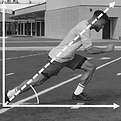
SPRINT KINEMATICS
The mechanics of sprint acceleration and max speed

KINOGRAMS
Multi-angled movement phase analysis

DECELERATION
Understanding the reduction of momentum

PATTERNS
Recurring movement patterns found in sport
PATTERNS EXPLORED:
✓ Acceleration
✓ Max Velocity
✓ Deceleration
✓ Change of Direction
✓ Lateral Shuffle
✓ Hip Turn
✓ Curvilinear Running
✓ Backpedal
✓ 180° Transition

